
فروش فوری
What is a thermocouple? Complete review of types, performance and application in the industry Celsius industrial group
Ms. Nowrozinia, in this article we will examine in a complete and practical way what thermocouple is, how it works, what types it has and in what industries and equipment it is used. If you are looking for a detailed guide to choose a temperature sensor in industrial projects, furnaces, production lines, heating equipment or temperature control systems, this article can be a good reference for you.
What is a thermocouple?
Thermocouple is a temperature measurement sensor that is made by connecting two dissimilar metals. When the junction of these two metals is exposed to heat, a very small voltage is created. This voltage is related to temperature and is converted into temperature value through control equipment or displays.
Simply put, a thermocouple is a tool that is used in many industrial environments for high temperature measurement, good response speed and durability in harsh conditions.
How does a thermocouple work?
The basis of thermocouple operation is based on a phenomenon called Sibak effect. According to this principle, when two different metals are connected on one side and there is a temperature difference between the connection point and the other end, an electric driving force is produced.
Thermocouple operation process:
- Two dissimilar metals are joined together.
- The joint is exposed to the process temperature.
- The temperature difference between the hot junction and the reference creates a small voltage.
- This voltage is read by the controller, PLC, transmitter or display.
- The system converts the voltage value into the actual temperature.
Main components of thermocouple
Industrial thermocouple usually consists of the following parts:
- Thermocouple element: two non-homogeneous metal wires
- Hot connection point: temperature measurement location
- Protective sheath or sheet: to protect against corrosion, pressure and impact
- Thermocouple head: connecting wires and terminals
- Compensator cable: to transmit the signal to the system Control
- Mechanical connections: threaded, flanged or push-in
Types of thermocouples
Thermocouples are divided into different types based on type of metal. Each type has its own temperature range, precision, chemical resistance and application.
What is the most widely used type of thermocouple?
In many industries, the K-type thermocouple is the most widely used option. The reason for this:
- Wide temperature range
- Reasonable price
- Good resistance in industrial conditions
- Compatibility with various control equipment
- Easy access in the market
For this reason, it is very common in production lines, heating equipment, furnaces, metal industries and industrial machinery.
Advantages of thermocouples
The use of thermocouples is common in industry for many reasons. The most important advantages are:
- High temperature tolerance
- Suitable response speed
- Simple and durable structure
- Economical price in many models
- Usability in harsh industrial environments
- Variety in dimensions, sheaths and connections
- Suitable for installation at different points of equipment
Disadvantages of thermocouple
Besides the advantages, the thermocouple also has limitations:
- Its accuracy is usually lower than RTD
- Output voltage is very low and sensitive to noise
- Needs cold junction compensation
- In some corrosive environments, its life is reduced
- In case of wrong choice of sheath or type, error will occur
Difference between thermocouple and RTD
One of the common questions in the industry is the difference between a thermocouple and an RTD. Both are used to measure temperature, but they differ in function and application.
Application of thermocouple in industry
Thermocouple is used in various industries due to its simple structure, mechanical resistance and high temperature tolerance.
The most important applications:
- Industrial furnaces
- Boilers and boilers
- Steel and casting industries
- Petrochemical and oil and gas industries
- Ceramic and glass industries
- Production machinery
- Industries Food
- Packaging lines and thermal equipment
- HVAC and industrial ventilation systems
- Reactors and laboratory equipment
Application of thermocouple in industrial furnaces
One of the main places where thermocouples are used is industrial furnaces. In furnaces, accurate temperature control is very important, because the quality of the final product is directly dependent on the process temperature.
In this field, thermocouple is used for the following:
- Controlling the temperature of the furnace chamber
- Monitoring the temperature of the part or material
- Protecting the equipment against excessive temperature rise
- Sending data to the PLC and temperature controller
- Optimizing energy consumption
What features should an industrial thermocouple have?
A suitable thermocouple for the industrial environment should be selected based on the actual process conditions. The most important features:
- Suitable type with temperature range
- Sheath material suitable for the environment
- Resistance to vibration and impact
- Corrosion resistance
- Suitable probe length and diameter
- Connection type suitable for installation
- Acceptable accuracy and response time
Types of thermocouples in terms of structure
In addition to the metal type, thermocouples are also classified in terms of design and structure:
1. Sheathed thermocouple
It has a protective metal sheet and is suitable for most industrial environments.
2. Flange thermocouple
Used for installation on tanks, lines or special equipment.
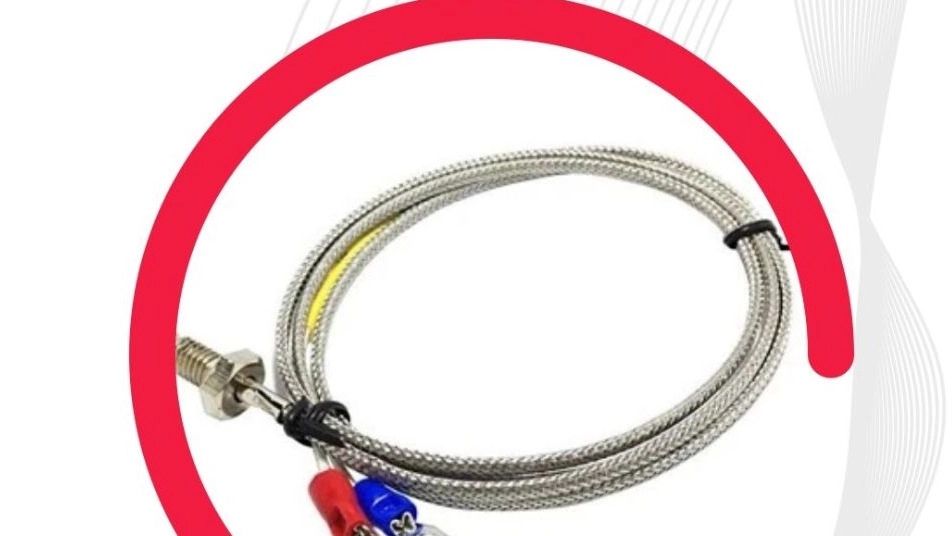
3. Threaded thermocouple
It is used for easy installation in machinery and process equipment.
4. Headed thermocouple
There is an aluminum or steel head on top of it and it is suitable for terminal connection.
5. Thermocouple with socket or connector
Used in quick and replaceable applications.
6. Explosion-proof thermocouple
It is designed for dangerous environments such as oil, gas and petrochemical.
How to choose the right thermocouple?
To choose the right thermocouple, it is not enough to just know the temperature. A set of factors should be considered.
Selection criteria:
- Process temperature range
- Environment type: corrosive, humid, acidic, pressurized
- Installation type
- Required response speed
- Expected accuracy
- Type of control equipment
- Cost and useful life
- Maintenance conditions and Replacement
Example:
- For general industrial furnace usually type K
- for low temperature and food application usually type T
- for very precise processes and high temperature types R/S/B
Factors affecting thermocouple life
The life of the thermocouple depends on the quality of construction and operating conditions. Factors that reduce its life:
- Over temperature
- Thermal shock
- Chemical corrosion
- Severe vibration
- Wrong sheath selection
- Improper installation
- Incorrect cabling
- Contamination or oxidation of wires
Symptoms of thermocouple failure
If the thermocouple is not working properly, the industrial process will fail. Some signs of failure:
- Unrealistic temperature display
- Severe fluctuations in temperature reading
- Abnormal delay in response
- Signal disconnection and connection
- Large difference with reference thermometer
- Controller or PLC error
How to install thermocouple correctly
The correct installation of the thermocouple has a direct effect on its accuracy and life.
Important installation points:
- The installation point should be compatible with the actual location of the temperature process.
- Probe immersion should be sufficient.
- Use a suitable compensation cable.
In which industries is thermocouple used the most?
Metal industry
For furnaces, melting, heat treatment and casting
Oil, gas and petrochemical industries
To monitor the temperature of lines, tanks, reactors and converters
Food industry
To control thermal processes, baking, dryers and special cold storages
Ceramic and glass industries
For high temperatures and process uniformity control
Machine building industries
For temperature control in elements, nozzles, molds and production equipment
Why is thermocouple important in instrumentation?
In precision instrument and industrial automation systems, temperature data is one of the most critical parameters. Thermocouple as a reliable sensor allows:
- Keep processes stable
- Control energy consumption
- Increase the quality of the final product
- Increase equipment safety
- Prevent damage caused by unauthorized temperatures
summary
Thermocouple is one of the most widely used temperature sensors in the industry, which is used in many industrial processes due to its high resistance, diversity, wide temperature range and reasonable price. Choosing the right type of thermocouple, sheath material, mechanical structure, and installation method plays an important role in measuring accuracy and equipment life.
If you are dealing with temperature control, furnaces, elements, thermal equipment, process lines or instrumentation systems in an industrial project, thermocouples can be one of the best options for temperature measurement and monitoring; Of course, provided that it is chosen according to the actual conditions of the process.